Thursday, August 26, 2010

Adventures in South Africa - The Kgalagardi Transfrontier Park

The Kgalagardi Transfrontier Park straddles the border between South Africa and Botswana and comprises two adjoining national parks: Kalahari Gemsbok National Park in South Africa and Gemsbok National Park in Botswana. Its total area is 38,000 square kilometers (15,000 sq miles). Approximately three-quarters of the park lie in Botswana and one-quarter in South Africa.  The terrain consists of red sand dunes, sparse vegetation with occasional trees, and the dry riverbeds of the Nossob and Auob rivers. The rivers flow only about once per century, but a flow of water underground provides life for grass and camelthorn trees growing in the riverbeds.

The weather in the Kalahari can be extreme.  Midsummer temperatures are often in excess of 40 °C (104 °F) and winter nights can be quite cold with temperatures below freezing.  Regardless of the hardships, the park has abundant wildlife. It is the home of large predators such as the black-manned Kalahari lion, cheetah, leopard, and hyena. Migrating herds of large herbivores such as wildebeest, springbok, eland, and hartebeest also live in the park.

There are three well-equipped camps on the South African side of the park, namely Twee Rivieren, Nossob and Mata Mata.  From Upington, Twee Rivieren is 260 kilometers north and it the closest.  We spent one night there before going as far north as Nossob.  We returned to Twee Rivieren for one more night before leaving the park.  All camps have a small shop with food, ice and drinks as well as fuel pumps.  Hundreds of ground squirrel dens also litter the camping areas.  Their antics are truly fun to watch while resting around the campfire, but watch where you place your feet.

The arid landscape of the Kalahari reminded me of Etosha National Park in Namibia, but the dry riverbeds gave it more contour.  The grass can be quite high, so being in a truck, high off the ground, gave us a game spotting advantage.  Also note, many of the roads through the Transfrontier require a 4x4 and should only be attempted in a caravan of at least three vehicles.  That said the game viewing was tremendous.  Our first night, we went on a night drive with a park ranger.  Among many other animals, we saw an Egyptian cobra, bat-eared foxes, springhares, many night birds and countless species of antelope.  Over the next few days, we had the luck to see leopard, cheetah, jackal, hyena, giraffe, zebra, wildebeest, hartebeest, eland, gemsbok, springbok, and so much more.  However, the highlight for me was when we were leaving the park and ran across a pride of lion feeding at a gemsbok kill.


Sunday, August 15, 2010

Traveling through Southern Africa (Part15) – The Fish River Canyon

The Fish River Canyon is one of the great natural wonders of Africa. It is one of the largest canyons in the world ranking with the Colca Canyon in Peru and the Grand Canyon in the U.S.A. The Fish River has its source east of the Naukluft Mountains and from there it flows down into the great Orange River. The river has cut a canyon into the escarpment more than 150 kilometers long, up to 27 km wide, and in places, almost 550 meters deep. The lookout points from the top give breathtaking views, especially at sunset when orange light bathes the canyon walls. 

The Fish River Hiking Trail starts at Hobas and ends 85 kilometers (53 miles) further south at the hot springs resort village of Ai Ais. No facilities are available and hikers must make their own camps for the entire trip, which usually takes about 5 days to complete.  Due to high summer temperatures, which frequently exceed 45°C, the trail is only open in winter. The season runs from mid-April to mid-September (wintertime in the Southern Hemisphere). A medical certificate is required to attempt the hike and groups must consist of at least three people.

We would have loved to walk the entire trail, and hope to do so someday, but this time the schedule only allowed us the afternoon to descend to the Orange River and back.  It was a walk that took 45 minutes down and about twice as long to climb back up.  The trails are in good
condition, but hard, very rocky and at times confusing.  We learned just to continue downhill for a short while and the path would reappear.  It was a walk into another realm. The trail is full of interesting rock formations, plant life and the occasional reptile, well worth the effort to experience.

Upon returning to the lookout, the setting sun rewarded us with some breathtaking views of the canyon.  I am always amused by the fact that the more rugged the landscape the more beautiful it appears from afar.

Sunday, August 8, 2010

Traveling through Southern Africa (Part14) – luderitz, Kolmanskop and Halifax Island


Luderitz is a German colonial town on the Namib Desert coast, seemingly untouched by the 20th century.  It began life in the late 1800s as a harbor and trading post, but the bay’s shallow water and rocky bottom, make it unusable for modern ships.  Today Luderitz is a tourist town with shops and restaurants.  Its main draw for visitors are wildlife cruises and the nearby ghost town of Kolmanskop.

Just off the coast is a marine wildlife sanctuary that can be visited by boat.  There, you have an opportunity to see African penguins, sea lions, white-sided dolphins, flamingos and many other marine bird species.

The day after arriving in Luderitz, we walked to the harbor from our campsite to board the schooner, Sedina, for a morning cruise.  We sailed into luderitz bay,  past the lighthouse at Diaz Point and on to Halifax Island.  Several dolphins showed us the way and accompanied us for most of the excursion. 

As we approached Halifax island we saw sea lions basking in the sun, and along the rough ragged rocks, penguins jumped in and out of the waves.   the water was choppy and the schooner did its best to hold position.  Overhead flamingos flew to feed in the shallows of the bay.  On our return trip into the harbor, we were again joined by the dolphins.


 In the afternoon, we visited Kolmanskop.  The last resident left the diamond boom town in 1956 and the once thriving settlement now sits crumbling in the desert 15 kilometers inland from Luderitz .  It is gradually being buried by the sand, but it is still a fascinating place to visit, offering great photo opportunities and a glimpse into an exciting part of Namibia's past.

Sunday, August 1, 2010

Traveling through Southern Africa (Part13) – The Namib Naukluft Park: Sossusvlei

The Sossusvlei and the surrounding sand dunes of the Namib Naukluft National Park are one of the most spectacular sights in Namibia.  'Vlei' is the Afrikaans word for a shallow depression that fills with water ,and the Sossusvlei refers to the pan that lies at the very end of the Tsauchab Riverbed where the dunes prevent water (on the rare occasions when there is any) from flowing any further into the desert.

These beautiful, red sand dunes are some of the highest in the world (Some as high as 300 meters) and present some awe-inspiring images against a nearly cloudless blue sky.  The midday heat is intense and the sun is so strong that it washes out the colors.  The best time to view the Sossusvlei is close to sunrise and sunset when the colors are strong and the shadows are constantly shifting.


The night before our visit, we stayed at the Sesriem gate campsite in the park.  In the morning, we were up before the sun and drove the one hour to the 2x4 parking area.  We left the truck there and continued by foot for the last four kilometers of our journey to arrive at the Sossusvlei as the sun was rising over the dunes.

 After taking some time for photographs, we met up with a park guide who showed us many of the plant and animal species, which live in an environment that on first glance looks devoid of life.  There are lizards that keep cool by burying themselves in the sand, Fog Beetles that catch the humidity in the morning wind and plants that store their water inside cucumber-like fruit.

Later, we took the time to climb one of the dunes for a view of the surroundings.  It was a hard climb through soft sand, but our reward was worth it - a landscape of stark, high sand dunes stretching to the horizon.  It gave me the feeling of insignificance and awe. It was truly an adventure in traveling.

Sunday, July 25, 2010

Traveling through Southern Africa (Part12) – Swakopmund and the Namib Desert

Swakopmund is Namibia's second biggest town and its summer capital.  It was founded in 1892 as the main harbor for German South-West Africa, and many of its buildings stand as examples of German colonial architecture.  Since the climate on the coast is cooler than the interior of the country, government traditionally moves from the country’s official capital, Windhoek, to Swakopmund for the hotter months.


Today, Swakopmund is a seaside resort.  It is known to travelers for its adventure sports such as quad-biking, parachuting and sand surfing, as well as for the beauty of the surrounding desert.  If you’ve been traveling for a while, Swakopmund is the place to rejuvenate.  However, the town is not all tourism.  Like every Southern African town of any size, it has its poor.  Along with all the other activities, I highly recommend a guided tour of the Swakopmund townships.  It is a rare opportunity to meet and spend time with some of the people who live there.


On our tour, a tribal elder invited us into his home for a chat and later we spent much of the evening watching children and families going about their evening.  It was a pleasure to watch children dancing in the alleys and to hear singing coming from all over the township.


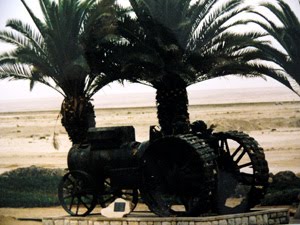
The next day we drove out into the desert to admire the arid landscape. On a dusty hillside rests the Martin Luther, a stream engine left there to rust since 1896 as a testament to the unforgiving terrain.
 Nearby, there are welwitschia; ancient plants that can live for 2000 years and proof that life can exist even in the harshest climate.

Later, we returned to the hotel.  We washed our clothes at a nearby Laundromat, ate dinner in a nice restaurant, and took one last shower.  Tomorrow we would head back into the desert for our next adventure in traveling.

Sunday, July 18, 2010

Traveling through Southern Africa (Part11) – Twyfelfontein

Twyfelfontein is a rocky sandstone outcrop seated in the Kunene Region of Namibia. The area has one of the largest and most important concentrations of rock art in Africa with some 2000 petroglyphs created over the course of two thousand years (ending around 1000 AD).  Archeologists believe hunter-gathers carved the figures into the boulders of Twyfelfontein as part of their ritualistic activity. The carvings represent rhinoceroses, elephants, ostriches and giraffes, as well as depicting human and animal footprints.

We drove from the small town of Khorixas along some very dusty dirt roads for 90 kilometers to Twyfelfontein.  The desert scenery in the region known as Damaraland is spectacular, and in itself, is worth the drive.  Unexpectedly, we came across an elephant standing in the middle of the road and had a short break while we waited for him to give way.   For me, these little inconveniencies are what make travel in Africa an adventure.

Once at Twyfelfontein, we met a local guide who took us along the well-tended trails through the petroglyphs.  He pointed out the highlights, but he was hard to understand.  All I really got out of his talk was that Twyfelfontein is Afrikaans for doubtful fountain and that a farmer who once homesteaded the area had named it.

Happily, after- wards we were free to roam the area.
The day was bright and hot as most days in the region are.  For the next few hours, we explored the many rock faces and shaded overhangs to discover for ourselves the artworks hidden from plain site.  It was a great insight into how the ecology of the area had changed from bush to desert over the millennia and into the minds of the ancient people that once lived in the area.  


Sunday, July 11, 2010

Traveling through Southern Africa (Part10) – The Himba People of the Kunene, Namibia

Partially due to its inaccessible mountainous geography and partially due to its harsh arid climate, Kunene is a relatively underdeveloped region in northern Namibia.  Perhaps for these very reasons, the Himba People that call this region home still live with little (but nonetheless growing) influence from the outside world and have managed to maintain much of their traditional lifestyle.
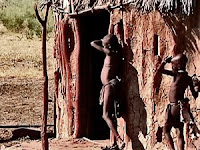
The Himba are a mostly nomadic pastoral people, breeding cattle and goats.  They are an offshoot of the Herero people and speak a dialect of the Herero language.

Traditionally, women tend to handle more labor-intensive work than the men do.  They carry water to the village, build the huts and care for the children. Men are responsible for maintaining relationships between clans and for tribal politics.  Both men and women go topless and wear skirts or loincloths made of animal skins, but most famously, the women are known for covering themselves with otjize, a mixture of butterfat and ochre that gives their skins a reddish-orange tinge.


Our Adventure started with a drive north to the town of Opuwo, Namibia.  Once there, and after several hours of searching, we meet the guide who would make our introductions to a Himba clan.   At his request, we bought a large sack of rice to give the clan as a gift, then left town in our overland truck in the direction of the Angolan border.

It was a hot dusty drive along some very rough roads, but eventually we approached a collection of huts and shelters sitting unprotected in the afternoon sun.  We had to wait in the truck while the driver and guide made their introductions and presented the sack of rice, but once they concluded the formalities, the clan allowed us to move freely around the village.

An impromptu Himba market

During the day, the adult men are with their animals, so only women and children were in the village.  They gathered under one of the few trees in the area and began laying out handmade trinkets in hopes of making a sale.  I made friends with a few of the boys by photographing them with my video camera and playing it back for them to watch.  In the meantime, Denise was making friends by allowing the children to fix her hair.  She ended up with ochre handprints all over the back of her shirt.

We remained with the clan for a few hours, but eventually returned to the truck, parched and in need of water.  Luckily, our overland truck carries a few hundred liters, but when the women saw us filling bottles from the water tap, they decided they could save themselves the daily walk to the river.  They came with their buckets and only said goodbye when they had drained the last of the water in the tank.  It was another great experience and a true adventure in traveling.

Saturday, July 3, 2010

Traveling through Southern Africa (Part9) - Otjitotongwe Cheetah Farm

Estimates put the worldwide cheetah population at less than 7,500 cheetahs of which 6,000 are in Southern Africa.  Nearly half of those cheetahs are in Namibia, mostly on private game or cattle farms.  Unfortunately, some farmers continue to hunt cheetah because of their tendency to kill livestock. The Otjitotongwe cheetah farm gives sanctuary to those cheetahs that farmers might otherwise kill.


On the 7,000-hectare farm, there are both wild and tame cheetahs.  At present, there are around 13 wild cheetahs that live in a 40 hectare fenced enclosure and 3 tame cheetahs that live at the farmhouse.  The tame cheetah’s role is to educate the public, and visitors to the farm will have the chance to interact with them.

We arrived at Otjitotongwe Cheetah Farm in the early afternoon and drove directly to the farmhouse to meet the Nel family.  Outside, in the fenced backyard, they told us about their struggles with farming in Namibia and their now peaceful coexistence with the cheetahs.  All the while, one of the tame cheetahs weaved between the legs of her owner, looking for affection and purring just like a house cat.  Later, Nel gave us the opportunity to approach and run our hands through her thick soft fur.


After making camp on the farm, we returned to the Nels to join them for the evening feeding of the wild cheetah.  He explained to us that a 40-hectare enclosure could not possibly support the 13 cheetah now taking refuge there, so feeding was a necessity.  We drove into the enclosure in two open trailers with a trashcan full of donkey meat.  The cheetahs heard the truck’s engine and began approaching even before we stopped.  At one point, one of the cats jumped into the back of a trailer.  He seemed more upset by what he had done than the people surrounding him, and immediately jumped back out- no harm done.


Soon, Nel was throwing chunks of meat into the gathering of waiting cheetah.  With each toss, a small fight broke out and abruptly ended with one of the cheetah running into the bush with his prize.  It was an interesting experience, a good photo opportunity, and it did make one realize that the place for wild cheetahs was not on a farm.

Sunday, June 27, 2010

Traveling through Southern Africa (Part 8) –Etosha National Park, Around Okaukuejo

Okaukuejo is at the western end of the Etosha Pan. It is the oldest tourist camp in Etosha and is the administrative hub of the park.  Due to the lack of any other nearby water, the camp’s permanent waterhole is often busy.  There you will see a wide diversity of wildlife all day and late into the night under floodlights.  On any given evening, you can expect to see springbok, wildebeest, zebra, gemsbok, jackal, hyena, and most nights, black rhino, elephant and lion.  Because of the excellent and comfortable game viewing from a platform less than 50 meters away from the well lighted waterhole, it is one of the major attractions in the park and the good spots get taken up quickly.  My advice is to arrive early (before sunset) with plenty of food and drink to last the evening.  Don’t stress over it too much though; Etosha is full of incredible game viewing opportunities everywhere you go.

That night in Okaukuejo, we arrived late, but were able to squeeze onto a bench with a fairly good view of the waterhole.  The evening started slowly, with a few lapwings near the water’s edge.  Then a jackal approached, followed by zebra, and shortly after, gemsbok.  The stars of the evening didn’t arrive until well past 9PM when a mother black rhino and her calf came strolling into the light.  After that, we went to bed, but heard the next morning that lions had come in around eleven. No matter, the morning game drive more than made up for the missed lion.


That morning after a good hyena sighting, we came across a waterhole in a very arid area of the park selfishly guarded by a pride of lion.  There were at least eight of them including two males.  We stayed there for quite a long time and watched as a herd of zebra stood at a distance waiting for a chance to approach the water, but before anything happened we had to leave and return to camp.  It was time to head out on the next leg of this Adventure in Traveling.

Sunday, June 20, 2010

Traveling through Southern Africa (Part 7) –Etosha National Park, Around Namutoni Camp

Etosha National Park covers an area of 22,270 square kilometers.  It is home to 114 mammal and 340 bird species.  Etosha means "Great White Place" and the park is dominated by a massive mineral pan, the floor of which was formed around 100 million years ago and covers around 25% of Etosha. The pan fills only if the rains are heavy and even then the water stays only for a short time. This temporary lake attracts thousands of wading birds including flocks of flamingos.

Due to the arid grasslands and open bush, the game viewing in Etosha National Park is excellent, especially around the many waterholes.  Visitors to the Etosha reserve can expect to see many antelope species, elephant, giraffe, hyena, rhino and lions.  In the entire park, there are only three rest camps - Namutoni, Halali and Okaukuejo (plus a new luxury camp, Onkosh).  We entered the park by the Von Lindequist Gate where a warthog suckling her young greeted us.  That night, we stayed at Namutoni.

Every camp has a lighted waterhole and seating on the camp side of an electric fence so that guests can enjoy the nightlife in safety.  That night we watched jackal, zebras, springbok and rhino before walking back to the tent for an early night.
 

We left camp at 6AM the next morning for a game drive. I had never seen such large herds of springbok, wildebeest and zebra congregating around the water holes.  We even had the opportunity to watch the long awkward process of giraffe lowering their heads to the water for a drink.
 
 Later in the morning, we had our first sightings of hyena and lion, but with the sun growing stronger, the day was getting hot, so by late morning it was time to head back to Namutoni for a large breakfast.  After a rest, it was time to break camp and head to the next adventure.